

A Parent's Guide to Beginner D&D
My Child Wants to Play D&D. Where Do We Start?
What they need, what a first club actually feels like, and how to find a group where a new player can settle in.
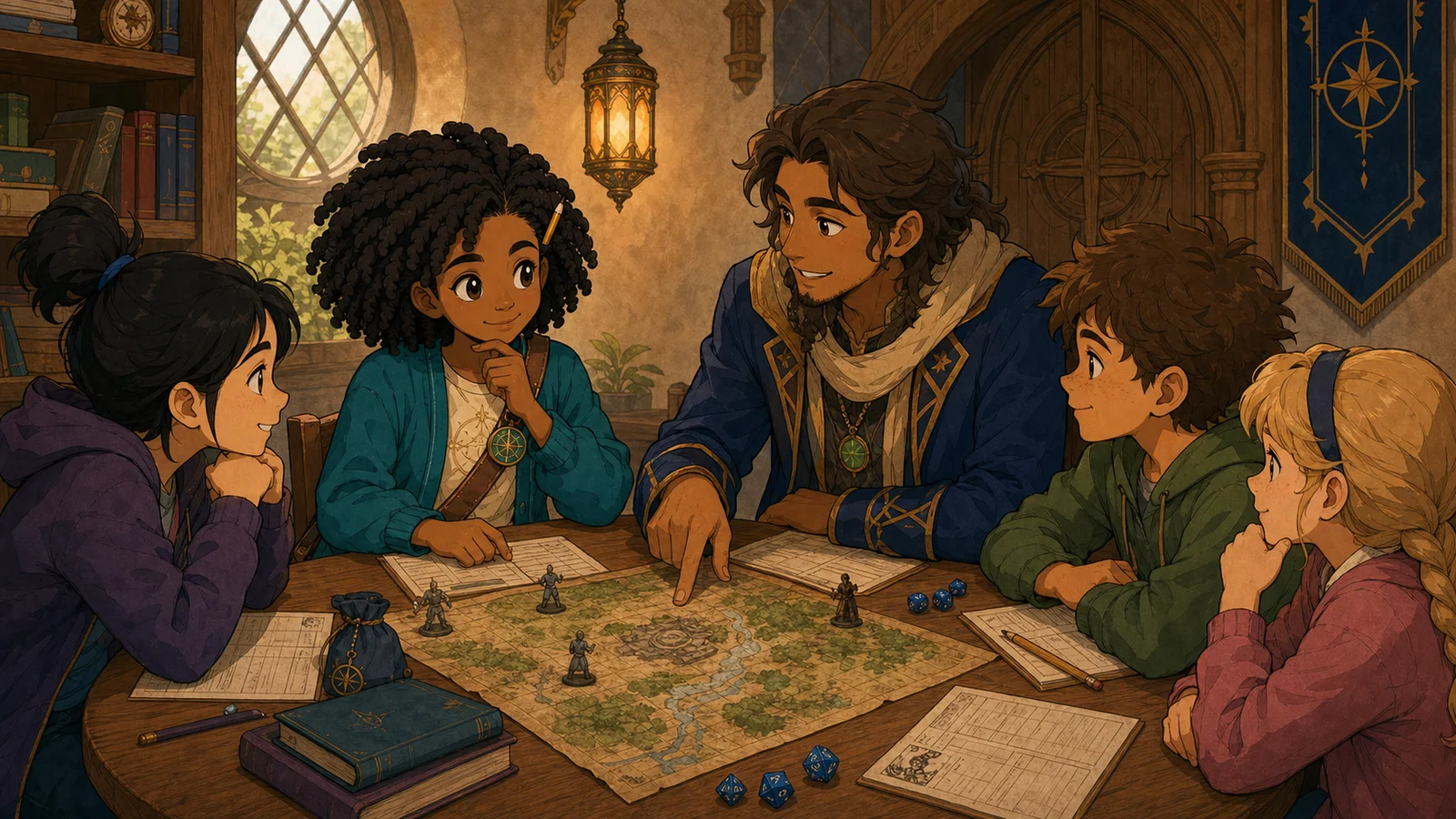
Your child has announced that they want to play Dungeons & Dragons. Wonderful. There is just one small problem: you may have no idea what that actually involves.
Start with the group, not the rulebook
D&D looks complicated from the outside because there are dice, character sheets, spells, maps, and a very large rulebook. None of those things matter as much as the people around the table.
For a new player, the best first group is small enough for everyone to have a turn and guided by an adult who enjoys helping kids learn. The Guild Master explains what matters in the moment, gives players room to make their own choices, and keeps the story moving when someone is unsure what to do next.
Your child does not need to memorize the rules before joining. They need a group where it is safe to ask, “Wait, which die do I roll?”
What your child actually needs
For an online club, the practical list is short:
- A computer or tablet that can join the club's video call
- A reliable internet connection
- A reasonably quiet place to participate
- A willingness to listen, take turns, and make choices with the group
Some clubs use a digital character sheet or virtual dice. Others begin with a ready-to-play character so a child can get into the story quickly. The club description should explain anything unusual they need to bring.
Costumes, miniature figures, and a dramatic collection of dice are fun, but optional. Those tend to appear later, once a player has decided that this is absolutely their thing.
What happens in a first D&D club?
A first session usually begins with introductions and a simple explanation of the setting. The Guild Master might ask each player to describe their character, choose between a few actions, or help the party solve a small problem together.
Maybe the group needs to cross a bridge guarded by a suspicious creature. One player wants to sneak past. Another tries to make the creature laugh. Someone else remembers an object on their character sheet that might help.
The Guild Master explains when a roll is needed, what to roll, and what the result means. The rules arrive in useful pieces. A new player learns because the rule connects to something they are trying to do, not because they studied it in advance.
A good beginner club leaves room for different play styles
Not every child walks into a new group ready to deliver a heroic speech. Some want to observe for a few minutes. Some immediately start planning. Some make the table laugh. Some become deeply invested in one mysterious door that everyone else was prepared to ignore.
A thoughtful Guild Master notices those differences and creates more than one way to participate. A quieter player might be invited to examine the map or make one clear decision. A highly enthusiastic player can be given a meaningful job that still leaves space for everyone else.
The goal is not to make every child play the same way. It is to help the party make room for each person's way of contributing.
How to tell whether a club is a good fit
Before enrolling, look for a few practical signs:
- The age range is narrow enough for the conversation and humor to feel comfortable.
- The description clearly welcomes beginners if your child is new.
- The group is small and guided rather than an open, unmoderated server.
- The schedule is realistic for your family to attend consistently.
- The tone matches what your child enjoys, whether that is funny, mysterious, adventurous, creative, or strategic.
It is also fair to ask what happens when a player misses a week, how behavior expectations are handled, and whether the same children usually return each week. You can read more about our approach on the Safety and Community page.
What if we choose the wrong group?
Parents often feel pressure to make the perfect choice from a list of club titles. Children are more complicated than a filter menu.
That is why Guild of Imagination treats the first four weeks as a fit test. You tell us about your child, we help find a group that seems promising, and your child gets time to experience the people, the Guild Master, and the rhythm of the club.
New families can try their first four weeks for $7 through the Adventure Pass. If they love the group and continue afterward, the club's normal recurring price begins. Exploring the Adventure Pass does not commit your family to long-term recurring tuition.
Questions parents often ask
Does my child need to know the D&D rules first?
No. A beginner-friendly club should teach the rules as they become useful in the story. Curiosity and a willingness to participate matter more than preparation.
Do we need to buy books or dice?
Usually not for a first online club. Check the individual club description, but many groups use digital tools or provide what a beginner needs to start.
What if my child is quiet in new groups?
Quiet participation is still participation. A good Guild Master gives a new player clear openings without putting them on the spot and lets confidence develop through familiar faces and repeated play.
Is D&D only about fighting monsters?
No. A session can include mysteries, conversations, exploration, puzzles, planning, jokes, and unexpected solutions. Many memorable moments happen when a party chooses not to fight.
Where can I see current beginner options?
Visit our D&D Clubs page or use the Adventure Pass so we can help you narrow the choices.
You do not need to become the family D&D expert before your child begins. Find a welcoming group, let an experienced Guild Master handle the rules, and give your child enough time to discover whether these are the people they want to adventure with each week.
The dice can come later. The right table comes first.
Ready to find their first party?
Tell us about your child and we will help match them with a welcoming, beginner-friendly club. New families can try their first four weeks for just $7.
Start the Adventure Pass